Contents
- 1 Understanding Your Tooth Replacement Options
- 2 How Dental Implants Work
- 3 How Dentures Work
- 4 Dental Implants vs Dentures: A Detailed Comparison
- 5 Who Is a Good Candidate for Dental Implants?
- 6 Who Is a Good Candidate for Dentures?
- 7 The Role of Technology in Modern Tooth Replacement
- 8 Frequently Asked Questions
- 9 Making the Right Decision for Your Smile
Understanding Your Tooth Replacement Options
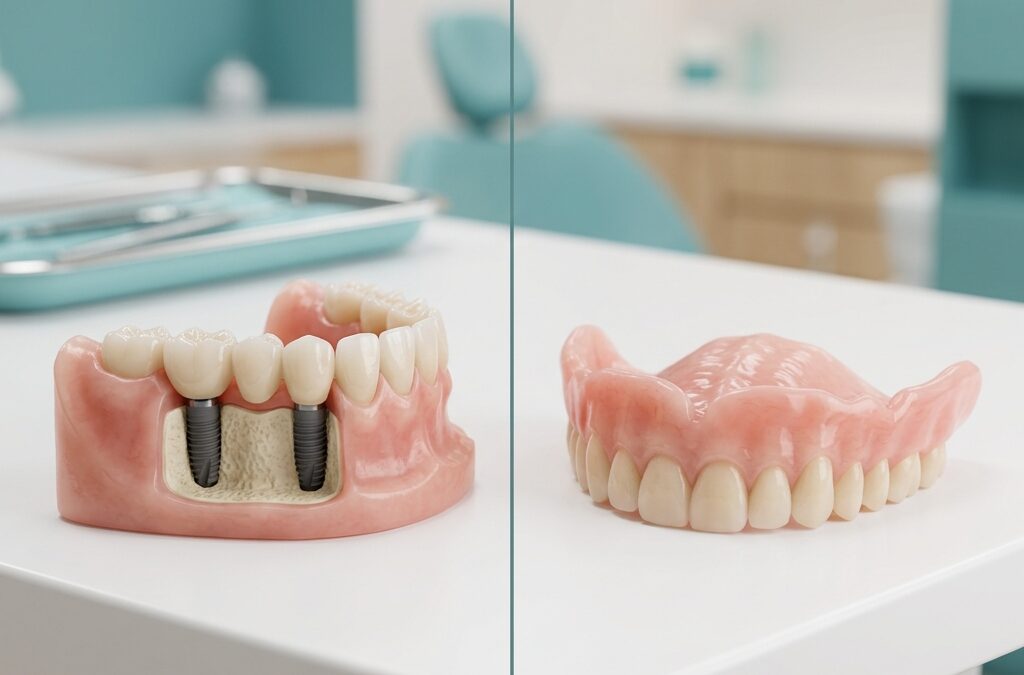
Losing a tooth — or multiple teeth — affects more than your smile. It changes the way you eat, speak, and feel about yourself in social situations. If you are weighing your options for replacement, the conversation usually comes down to comparing dental implants vs dentures. Both serve the same fundamental purpose, yet they work in fundamentally different ways, carry different price points, and deliver different long-term outcomes.
At Marina Dental, we walk every patient through the advantages and trade-offs of each option so the decision feels clear and personal rather than overwhelming. This guide covers everything you need to know — from how each treatment works to cost, durability, maintenance, and candidacy — so you can have an informed conversation with your dentist at your next appointment.
How Dental Implants Work
A dental implant is a small titanium post that a dentist or oral surgeon places directly into the jawbone. Over a period of three to six months, the bone fuses with the titanium through a biological process called osseointegration. Once the implant is securely anchored, a custom-made crown is attached to the post through a connector piece called an abutment.
The result is a replacement tooth that looks, feels, and functions almost identically to a natural tooth. You brush it, floss around it, and eat with it the same way you would with the tooth it replaced. Because the implant sits within the bone itself, it also preserves the jawbone structure and prevents the bone loss that naturally occurs after tooth extraction.
Types of Dental Implants
Not every implant case is the same. Depending on how many teeth need replacing and the condition of your jawbone, your dentist may recommend one of several approaches:
- Single-tooth implants: One titanium post supports one crown. This is ideal when a single tooth is missing and the surrounding teeth are healthy.
- Implant-supported bridges: Two or more implants support a bridge that replaces several adjacent missing teeth without requiring an implant for every individual tooth.
- All-on-4 implants: Four strategically placed implants support an entire arch of teeth. This approach is popular for patients who have lost most or all teeth in the upper or lower jaw and want a fixed, permanent solution.
- Mini implants: Smaller-diameter implants sometimes used for patients with insufficient bone density who cannot undergo bone grafting. They can also stabilize existing dentures.
How Dentures Work
Dentures are removable prosthetic devices that replace missing teeth and the surrounding gum tissue. They rest on top of the gums and rely on suction, adhesive, or the shape of the jaw ridge to stay in place.
Modern dentures are far more comfortable and natural-looking than the dentures of previous decades. Advances in dental materials and fabrication techniques — including digital scanning and 3D printing — have made it possible to create dentures that closely mimic the appearance of natural teeth and gums.
Types of Dentures
- Full dentures: Replace all teeth in the upper jaw, lower jaw, or both. These are designed for patients who have lost every tooth in an arch.
- Partial dentures: Replace one or more missing teeth while the remaining natural teeth serve as anchors. Metal clasps or precision attachments hold the partial denture in position.
- Immediate dentures: Placed on the same day that teeth are extracted. They serve as a temporary solution while the gums heal and a permanent denture is fabricated.
- Implant-supported dentures (overdentures): A hybrid option where two to four implants anchor a removable denture, providing greater stability than conventional dentures while remaining removable for cleaning.
Dental Implants vs Dentures: A Detailed Comparison
Choosing between implants and dentures involves weighing multiple factors. Here is a side-by-side look at the areas that matter most to patients.
Appearance and Comfort
Dental implants are widely regarded as the closest thing to natural teeth. Because the crown is anchored to the jawbone, there is no slipping, no clicking, and no visible metal clasps. The crown is custom-shaded to match your surrounding teeth, making it virtually indistinguishable from a natural tooth.
Dentures have improved significantly in aesthetics, but they sit on top of the gums rather than within the bone. Some patients experience slight movement during eating or speaking, especially with lower dentures. Over time, as the jawbone changes shape due to bone resorption, dentures may need relining or replacement to maintain a proper fit.
Durability and Longevity
With proper care, a dental implant can last 25 years or longer — many last a lifetime. The titanium post itself rarely fails once osseointegration is complete. The crown on top may need replacement after 10 to 15 years due to normal wear, but the implant post remains.
Dentures typically last five to eight years before they need replacing. The underlying jawbone continues to resorb after teeth are lost, gradually changing the shape of the ridge and causing dentures to fit less securely over time. Regular adjustments and eventual replacement are part of the long-term cost of dentures.
Bone Health and Facial Structure
This is one of the most significant clinical differences between the two options. When a tooth is lost, the jawbone in that area begins to deteriorate because it no longer receives the stimulation it needs from a tooth root. Dental implants replace that stimulation, preserving bone density and maintaining facial structure.
Dentures do not stimulate the jawbone. Over years and decades, patients who wear conventional dentures may notice changes in their facial appearance — sunken cheeks, a shorter lower face, and a more aged look. This bone loss can also make it progressively harder to wear dentures comfortably.
Eating and Dietary Freedom
Implant patients can eat virtually anything — steak, apples, corn on the cob — without worry. The implant is anchored in bone, so bite force is comparable to that of natural teeth.
Denture wearers often need to avoid certain hard, sticky, or chewy foods. Biting into an apple or corn on the cob can dislodge a denture. Many patients adapt their diet over time, but the dietary restrictions are a consistent consideration.
Cost Considerations
Dental implants have a higher upfront cost. A single dental implant typically ranges from $3,000 to $6,000, which includes the implant post, the abutment, and the crown. Full-mouth rehabilitation with implants (such as All-on-4) can range from $15,000 to $30,000 per arch.
A complete set of conventional dentures typically costs between $1,000 and $3,000. However, when you factor in adhesives, periodic relines, replacements every five to eight years, and the potential need for bone grafting later, the lifetime cost of dentures can approach or even exceed the one-time investment in implants.
Many dental practices, including Marina Dental, offer flexible payment plans and financing options to make implants more accessible. It is worth discussing these options during your consultation.
Maintenance and Daily Care
Implants are maintained exactly like natural teeth: brush twice a day, floss daily, and visit your dentist for routine check-ups and cleanings. There is no special equipment or cleaning solution required.
Dentures require removal every night for cleaning. They need to be soaked in a denture-cleaning solution and brushed with a soft denture brush. The gums underneath also need to be cleaned. Proper denture care takes more time and involves additional products compared to implant care.
Who Is a Good Candidate for Dental Implants?
According to the American Dental Association (ADA), most adults with good general health are candidates for dental implants. The key requirement is sufficient jawbone density to support the implant post. If bone loss has occurred, a bone grafting procedure can often rebuild enough bone to make implants possible.
Certain conditions may affect implant candidacy or require additional planning:
- Uncontrolled diabetes can slow healing and affect osseointegration.
- Heavy smoking significantly increases the risk of implant failure.
- Certain medications, such as bisphosphonates used for osteoporosis, may affect jawbone healing.
- Active gum disease must be treated before implant placement.
A thorough evaluation — including dental X-rays or a 3D cone beam CT scan — will determine whether implants are right for your specific situation.
Who Is a Good Candidate for Dentures?
Dentures may be the better choice for patients who:
- Have significant bone loss that cannot be corrected with grafting.
- Have health conditions that make surgery inadvisable.
- Need an immediate, budget-friendly replacement while saving for a longer-term solution.
- Are missing all or most teeth and prefer a non-surgical approach.
Dentures also serve as an excellent transitional solution. Some patients begin with dentures and later upgrade to implant-supported dentures or full implants when their budget or health circumstances allow.
The Role of Technology in Modern Tooth Replacement
Digital dentistry has transformed both implants and dentures. At Marina Dental, we use advanced technology at every stage of the treatment process:
- Digital impressions eliminate the discomfort of traditional putty molds and provide more accurate results.
- 3D cone beam CT scans allow precise planning of implant placement, reducing surgical time and improving outcomes.
- CAD/CAM technology enables the fabrication of crowns and dentures that fit with exceptional precision.
- Guided implant surgery uses computer-generated surgical guides to place implants with millimeter-level accuracy.
These advancements mean shorter treatment times, better-fitting restorations, and more predictable results for patients choosing either option.
Frequently Asked Questions
How long does the dental implant process take from start to finish?
The entire process typically takes four to eight months. After the implant post is placed, a healing period of three to six months allows osseointegration. The final crown is then fabricated and attached. Some cases qualify for same-day implants, where a temporary crown is placed immediately after the post.
Can I get implants if I currently wear dentures?
Yes. Many patients transition from dentures to implants. Your dentist will evaluate your jawbone density and overall health to determine the best approach. In some cases, your existing dentures can be modified to fit over implants as an interim solution.
Are dental implants painful?
The procedure is performed under local anesthesia, and most patients report that the discomfort is less than they expected — comparable to a tooth extraction. Over-the-counter pain medication is usually sufficient for managing post-operative discomfort for the first few days.
How do I know which option is right for me?
The best way to decide is through a consultation with your dentist. Factors including your bone density, overall health, budget, lifestyle preferences, and long-term goals all play a role. At Marina Dental, we provide a comprehensive evaluation and walk you through every option so you can make the decision that fits your life.
Do dental implants require special cleaning tools?
No. You clean dental implants the same way you clean natural teeth — with a regular toothbrush, fluoride toothpaste, and dental floss. Your dentist may also recommend an interdental brush or water flosser for cleaning around the implant post.
Making the Right Decision for Your Smile
Both dental implants and dentures are proven, effective solutions for replacing missing teeth. The right choice depends on your individual health, goals, and circumstances. Implants offer a permanent, low-maintenance solution that preserves bone and feels like natural teeth. Dentures provide an accessible, non-surgical option that can restore function and appearance quickly.
What matters most is that you have the information you need to make a confident decision. At Marina Dental, our team is here to answer every question, walk you through every option, and help you choose the path that gives you the smile and quality of life you deserve.
Ready to explore your tooth replacement options? Schedule a consultation at Marina Dental today. We will evaluate your unique situation and create a personalized treatment plan tailored to your needs and goals.